
BJJ Student Tracking: Complete Guide
Student tracking is the foundation of a well-managed BJJ academy. From attendance to analytics that predict churn.
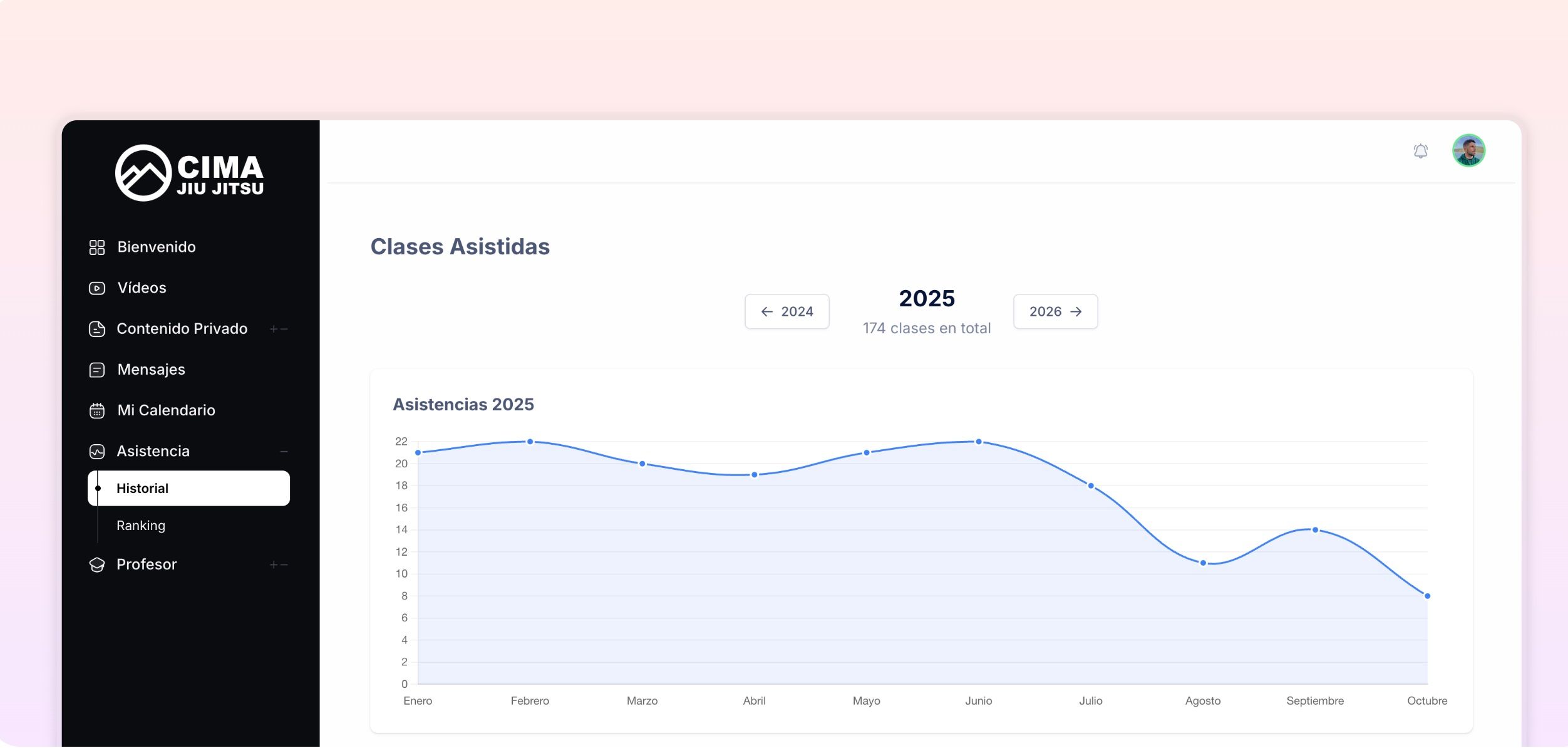
Student tracking is the foundation of a well-managed academy. Without it, promotions become subjective, certain students go unnoticed, and you’re navigating blindly when it comes to your students’ motivation—which your academy depends on to keep students enrolled.
In this guide, we cover everything from basic attendance tracking to advanced analytics that predict churn before it happens.
Table of Contents
- Why Tracking Matters
- Attendance Tracking Systems
- Belt and Stripe Progression
- Setting Promotion Criteria
- Kids vs Adults: Different Approaches
- Analytics and Reporting
- Choosing Tracking Software
Why Attendance Tracking Matters
Academies with attendance tracking see measurably better results:
- Higher retention — Students who see their own progress stay longer.
- Faster decisions — Promotion decisions are data-driven and take less time.
- Early churn warning — Detect attendance drops before students leave your academy for good.
Academies that struggle with retention almost always share one trait: they don’t know how often their students actually train, or even how many regular students they have.
The Hidden Cost of Not Tracking Attendance
Consider a 100-student academy with 15% annual churn. That’s 15 students lost per year at approximately €50/month each: €9,000 in annual revenue walking out the door.
If tracking helps you retain even 5 of those students before they leave, you’ve recovered €3,000 annually. The system pays for itself immediately.
Beyond the Numbers
Tracking isn’t just about business metrics. It has direct benefits for your students:
For the student:
- Visible motivation from seeing their accumulated progress.
- Clarity on what they need for their next promotion.
- A sense that their effort is recognized and valued.
For the instructor:
- Context before each class about who hasn’t attended recently.
- Objective data to support promotion decisions.
- Less time on administration, more time teaching.
For the academy:
- Proactive identification of at-risk students.
- Complete history for retention conversations.
- Data to optimize schedules and programs.
Attendance Tracking Systems
There are several ways to record attendance, from manual methods to fully automated systems. Each has its advantages and limitations.
Manual Methods
Paper sign-in sheets
The most basic method: a sheet where students sign when they arrive.
- Advantages: Zero cost, no technology required
- Disadvantages: Easy to forget, difficult to analyze, sheets get lost, students forget to sign
Spreadsheets
A step up: you manually record attendance in Excel or Google Sheets.
- Advantages: Allows basic searches and analysis
- Disadvantages: Requires manual entry after each class, prone to errors, doesn’t scale beyond 50 students due to time required before class
If you want to start with a spreadsheet, our free Student Tracking Template gives you a pre-built structure with attendance, belt progression, and payment tracking—ready to use in minutes.
In our experience, manual methods work up to approximately 30 active students. Beyond that number, the time invested in keeping records updated exceeds the benefit, and errors accumulate.
Automated Methods
Tablet check-in systems
Students tap a button on a tablet when they arrive. Their attendance is automatically recorded and synced with their profile.
- Advantages: No friction for the student, accurate real-time data, works without supervision
- Disadvantages: Requires a dedicated tablet, though at MatGoat we give you one for free!
Key features to look for:
- Offline capability (gym wifi is notoriously unreliable).
- Integration with student profiles.
- Automatic notifications for milestones (e.g., “Class number 100!”).
- Simple interface that requires no training.
Card or key fob systems
Similar to traditional fitness gyms.
- Advantages: Quick check-in, familiar to students coming from other gyms
- Disadvantages: Hardware cost, lost cards create problems and more management, plus additional costs
App-based check-in
Students record their attendance from their phone.
- Advantages: No hardware needed, the student already has the device
- Disadvantages: Depends on students remembering to check in, lower compl.iance rates (in our experience, 60-70% vs 95%+ with tablet)
Which Method Works Best?
The choice depends on your academy’s size and resources:
| Academy Size | Recommended Method |
|---|---|
| Under 30 students | Spreadsheets can work if you’re disciplined |
| 30-100 students | Dedicated tablet system |
| Over 100 students | Tablet + complementary app for students |
The deciding factor is usually time. If you spend more than 30 minutes weekly on attendance administration, an automated system pays for itself in recovered hours.
Belt and Stripe Progression
Recording attendance is the first step. Connecting that data with belt progression is where you see the real value of the system.
The Problem with Subjective Promotions
“I’ll know they’re ready when I see it” works for a handful of students. At scale, it creates problems:
- Inconsistency — Similar students promoted at different rates
- Instructor disagreement — Multiple coaches, multiple standards
- Student frustration — “Why did he get promoted before me?”
We’ve seen academies lose talented students because they felt the promotion system was arbitrary. Transparency in criteria isn’t just fair—it’s good for your academy.
The Reality of BJJ
Unlike other martial arts with strict curricula, BJJ has traditionally left promotions to instructor discretion. This makes sense: jiu-jitsu is a complex art where “time on the mat” matters as much as technique.
But “instructor discretion” doesn’t have to mean “no criteria.” The best instructors combine their judgment with objective data:
- How many classes has this student attended?
- How long have they been at their current belt?
- How do they perform against peers of similar level?
- Do they contribute positively to the academy culture?
Building a Progression Framework
A clear framework has three components:
1. Minimum time at each belt
BJJ requires maturation. Even naturally talented students need time for techniques to settle in.
- White to blue: 12-24 months typically.
- Blue to purple: 24-48 months typically.
- Purple to brown: 36-48 months typically.
- Brown to black: 36-60 months typically.
These are minimums, not guarantees. A student who trains once a week will need more time than one who trains five times.
2. Minimum attendance
This is where tracking data becomes valuable:
| Transition | Suggested Minimum Classes |
|---|---|
| White → Blue | 150-250 classes |
| Blue → Purple | 300-500 classes |
| Purple → Brown | 400-800 classes |
| Brown → Black | 500-800 classes |
Competition classes may count differently than fundamentals. Some instructors give extra weight to certain specific classes.
3. Technical benchmarks
Fundamental techniques the student must demonstrate at each level. This can be tracked through:
- Curriculum checklists
- Periodic evaluations
- Observed performance during rolls
For detailed implementation, we have a guide on Attendance-Based Promotion Criteria (coming soon).
Tracking Stripes
Stripes add complexity, especially in kids’ programs where motivation from visible progress matters more.
Common approaches:
- Time-based: One stripe every 2-3 months of consistent training.
- Attendance-based: One stripe per X classes.
- Skill-based: Stripes tied to specific technical benchmarks.
Which works best?
For kids, we recommend an attendance-based system with some adjustments for attitude and behavior. It’s objective, predictable, and teaches that consistent effort has rewards.
For adults, a hybrid approach works better: minimum attendance plus demonstrated technical competence.
For implementation details, see our Stripe Tracking Guide (coming soon).
Setting Promotion Criteria
The key is balancing objectivity with instructor judgment. Pure numbers lose context; pure subjectivity creates inconsistency.
A Balanced Framework
Objective requirements (must meet):
- Minimum time at current belt.
- Minimum attendance threshold.
- No major training gaps (e.g., 3+ months of absence may partially reset the count).
Subjective evaluation (instructor discretion):
- Demonstrated technical competence.
- Rolling ability against peers.
- Attitude and contribution to academy culture.
- Willingness to help less experienced teammates.
Example: Blue Belt Criteria
| Requirement | Threshold |
|---|---|
| Time as white belt | Minimum 18 months |
| Classes attended | Minimum 250 |
| Fundamental techniques | Checklist completed |
| Competition (optional) | At least 1 tournament recommended |
To Publish or Not Publish Criteria
There’s debate about whether criteria should be public. Our recommendation: yes, publish them—at least the minimums.
Arguments for:
- Students know exactly what they’re working toward.
- Reduces “when will I get promoted?” questions.
- Demonstrates your system is fair and transparent.
- Instructors have a framework for consistent decisions.
Arguments against:
- Some students obsess over numbers instead of improving.
- Can create a “meet the minimums” mentality.
- Less flexibility for exceptional cases.
The counterargument: if your criteria are well-designed, meeting them means the student is ready. And of course, “instructor approval” is always the final requirement.
Kids vs Adults: Different Approaches
Kids and adult programs need different tracking systems.
Kids Programs
Higher frequency feedback needed
Kids need more frequent positive reinforcement:
- More frequent graduations: keep motivation high.
- Visual progress charts work well in kids areas.
- Milestone celebrations matter a lot.
Parent communication
Parents want visibility into their children’s progress:
- Automated progress reports reduce “how is my child doing?” conversations.
- Attendance notifications provide peace of mind.
- Alerts when a child hasn’t come in X days allow follow-up.
Simpler criteria
- Attendance-based stripes work well and are easy to explain.
- Technical benchmarks kept simple and demonstrable.
- Emphasis on behavior and attitude in addition to technique.
Adult Programs
Longer timelines, less constant tracking
- Adults tolerate longer times between promotions.
- Detailed attendance statistics satisfy their curiosity.
- Less need for public celebrations (though recognition is still important).
Self-directed tracking
- Many adults want to see their own data.
- Student portals with attendance history and progression status.
- Ability to see remaining requirements for next promotion.
Schedule flexibility
Adults have jobs, families, and various commitments. Your system should:
- Track attendance without overly penalizing busy periods.
- Allow different training patterns (someone who trains 5x/week vs 2x/week).
- Recognize that long-term consistency matters more than short-term intensity.
For more on structuring differentiated programs, see our guide Kids vs Adults: Tracking Approaches (coming soon).
Analytics and Reporting
Attendance data becomes relevant when you analyze patterns. This is where tracking goes from administration to strategic tool.
Key Metrics to Track
At the individual student level:
- Classes per week (4-week average).
- Attendance trend (increasing, stable, decreasing).
- Days since last visit.
- Total classes since enrollment.
- Progress toward next promotion.
At the academy level:
- Average classes per student per month.
- Attendance by class type (fundamentals vs advanced vs competition).
- Correlation between attendance frequency and retention.
- Churn rate by belt (where do you lose the most students?).
- Attendance comparison between programs (kids vs adults).
Predicting Churn
Students rarely quit suddenly. Attendance drops weeks before they stop coming.
Warning signs:
- 1-2+ weeks without a visit (for previously consistent students).
- Drop from 3x/week to 1x/week.
- Stopped attending their usual schedules.
- Gradual reduction over 4-6 weeks.
What to do with these signals:
- Personal message — Not automated, but personal from their coach. “Hey, everything okay? We miss you.”
- Identify barriers — Schedules? Injury? Motivation? Financial issues?
- Offer solutions — Schedule adjustment, pause membership, re-engagement private class
- Follow up — If they return, celebrate. If not, at least you tried.
Academies that act proactively on churn signals recover 20-40% of students they would have otherwise lost.
Basic Monthly Reports
At minimum, review these numbers each month:
| Metric | Why It Matters |
|---|---|
| Active students (trained at least 1x) | Overall academy health |
| New enrollments | Growth |
| Cancellations | Churn |
| Average attendance per student | Engagement |
| At-risk students (no attendance 2+ weeks) | Proactive retention |
For a deeper dive, see BJJ Academy Analytics: Metrics That Matter (coming soon).
Choosing Tracking Software
Not all gym software handles BJJ tracking well. Generic fitness solutions lack specific features that martial arts academies need.
Features to Evaluate
| Feature | Why It Matters |
|---|---|
| Belt/stripe tracking | Generic software doesn’t have this |
| Attendance-promotion linking | Automates eligibility notifications |
| Student self-service portal | Reduces “how many classes do I have?” questions |
| Kids program support | Different progression rules than adults |
| Reporting and analytics | Data to make informed decisions |
| Integrated communication | Automated and manual messaging |
Questions to Ask Vendors
-
Is it specifically designed for martial arts? Generic fitness software will require constant workarounds.
-
How does check-in work? Is it simple? Do data get lost?
-
Can I configure custom promotion criteria? Every academy has its own system.
-
What do students see? Do they have access to their history and progress?
-
How does data migration work? If you have history in spreadsheets, can they import it?
Red Flags
Avoid software that:
- Requires long contracts before trying.
- Has no support in your language.
- Charges for basic features like belt tracking.
- Cannot show a demo with real BJJ academy data.
- Has negative reviews specifically about technical support.
Getting Started
The best time to implement tracking was when you opened your academy. The second best time is now.
If You’re Not Tracking Anything Today
Step 1: Start with digital check-in. Get attendance data flowing before worrying about belt progression rules.
Step 2: For the first month, just collect data. Don’t make changes based on it yet.
Step 3: At the end of the month, review patterns. Who are your most consistent students? Who hasn’t come?
If You Have Attendance Data But No Structure
Step 1: Define your promotion criteria. Use the framework in this guide as a starting point.
Step 2: Publish the criteria. Communicate them to your current students.
Step 3: Review current students against the new criteria. Are there pending promotions you should make?
If You’re Ready to Automate
Step 1: Evaluate software options using the questions from the previous section.
Step 2: Migrate historical data if you have it.
Step 3: Configure promotion criteria in the system.
Step 4: Train your team on the new workflow.
Step 5: Communicate the new system to students and its benefits for them.
Related Resources
- Attendance-Based Promotion Criteria (coming soon)
- Stripe Tracking Implementation Guide (coming soon)
- Kids vs Adults: Tracking Approaches (coming soon)
- BJJ Academy Analytics: Metrics That Matter (coming soon)
- Complete BJJ Academy Management Guide
This guide is part of the MatGoat Academy Management Series. For more resources on running a successful BJJ academy, explore our other guides.

BJJ practitioner, blue belt, always eager to keep learning and improving. Software engineer for over 15 years, I founded MatGoat to help BJJ and MMA academies continue growing.