
BJJ Belt Order: Colors, Kids’ Ranks and Stripes
See BJJ belts in order with adult and kids’ charts, stripe meanings, IBJJF ages and minimum times, including the June 2026 black belt update.
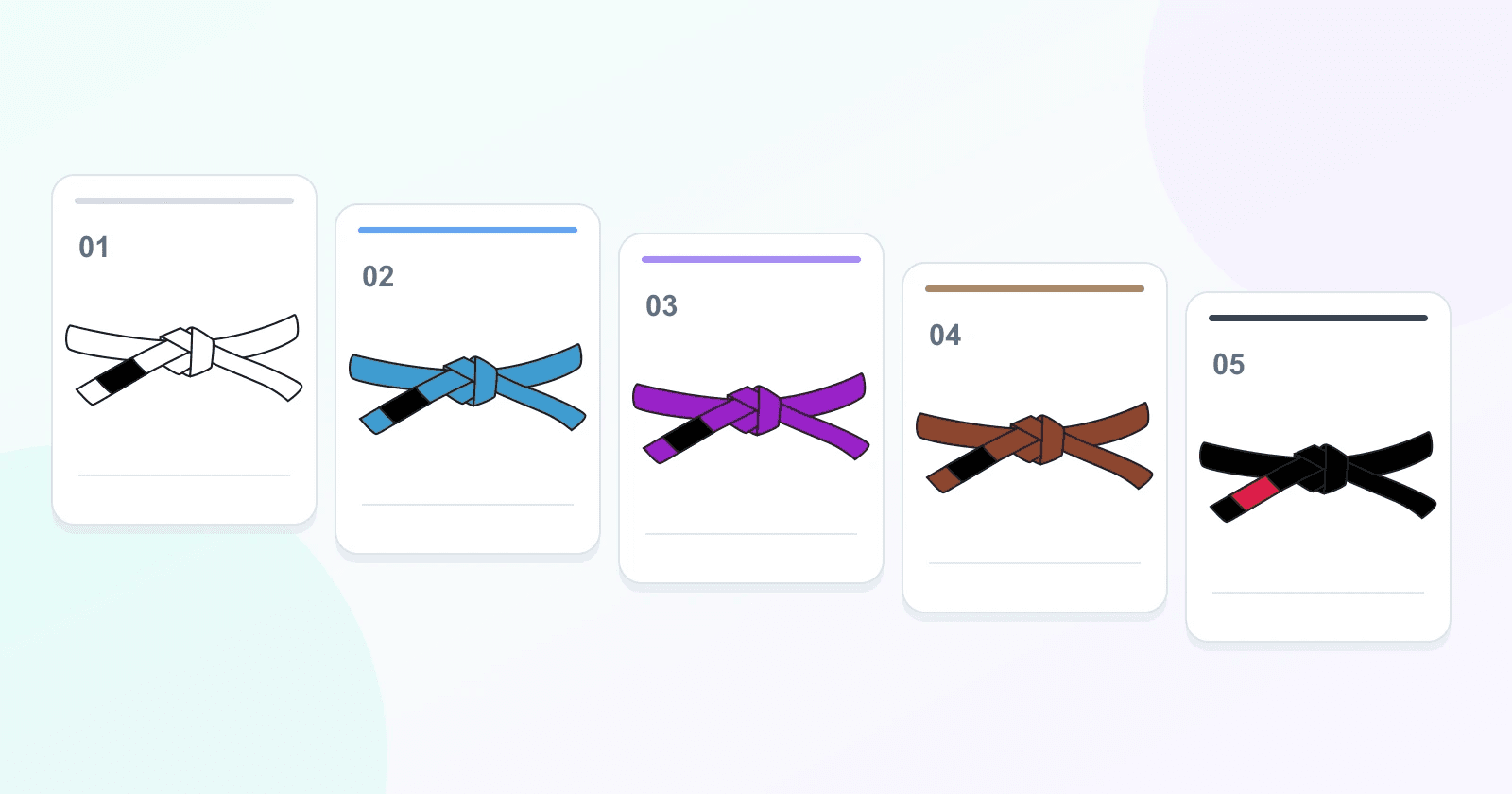
The main BJJ belt order is white, blue, purple, brown, then black. Brazilian jiu-jitsu also has a separate children’s sequence and senior ranks beyond black belt. Small stripes on a belt usually indicate progress within that rank.
This guide uses the June 2026 IBJJF General System of Graduation, checked on September 26, 2026, for ages, time requirements and degrees. The official graduation page links to the current document. Its rules govern IBJJF recognition; individual academies decide how they assess students and may follow other organizational systems.
BJJ belts in order: white to black
The sequence commonly called the “adult belt system” starts at 16, so it also includes the IBJJF Juvenile divisions. This chart shows the five main ranks and the minimum ages to hold them, with the black belt exception explained below.
-
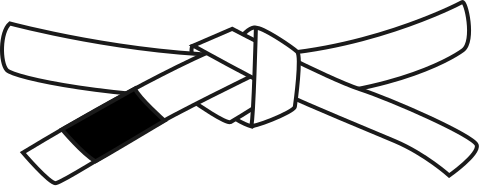 White Minimum IBJJF age: Any age
 -
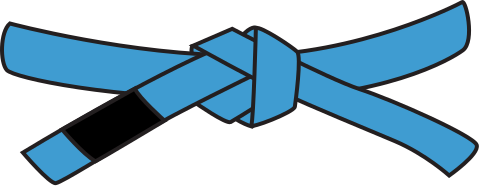 Blue Minimum IBJJF age: 16+
 -
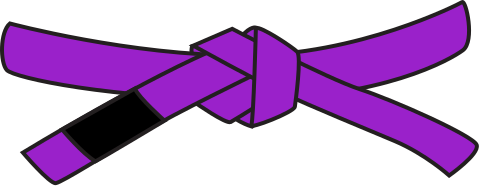 Purple Minimum IBJJF age: 16+
 -
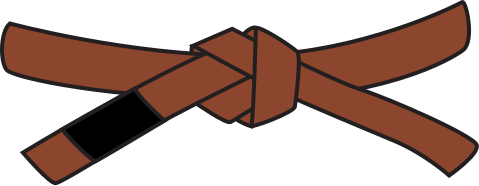 Brown Minimum IBJJF age: 18+
 -
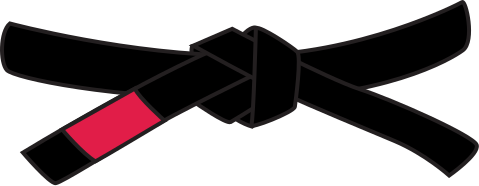 Black Minimum IBJJF age: 19+*
There are eight colors or combinations in the complete 16+ system when red-and-black, red-and-white and red are included. Those senior belts represent black belt degrees, so a beginner’s five-belt chart and the full eight-belt list answer slightly different questions.
BJJ inherited its use of colored ranks from judo, but the sequences differ. Wikipedia’s overview of BJJ ranking provides that historical context. Compare our judo belt order chart if you are moving between the two sports: a judo color does not automatically identify the equivalent BJJ rank.
What each BJJ belt means in practice
A color is a broad indication of experience. It cannot tell you someone’s preferred techniques, competition record or teaching ability. The following learning priorities are practical examples to discuss with a coach, rather than an official IBJJF examination syllabus.
| Belt | A useful training priority | An example to work on |
|---|---|---|
| White | Recognizing positions and protecting yourself. | Identify mount, side control and back control; practice a coached escape from each. |
| Blue | Building dependable responses. | Connect a guard recovery to a sweep or a safe return to standing. |
| Purple | Connecting a personal game. | Prepare a second attack when an opponent stops the first. |
| Brown | Improving efficiency and addressing gaps. | Review why a familiar pass fails against a particular defense. |
| Black | Refining judgment, adaptation and technical depth. | Explain the decisions behind a sequence and adapt it to different partners. |
A productive promotion conversation uses examples from training. Ask your instructor which positions need attention, what improvement would look like and when to review it. Attendance creates opportunities to learn; a class count alone does not establish technical readiness.
Kids’ BJJ belt order: all 13 ranks
The IBJJF children’s system covers ages 4 through 15. After white, it uses four color families: grey, yellow, orange and green. Each family contains three belts, giving 13 ranks altogether.
- White Minimum IBJJF age: Any age
- Grey / white Minimum IBJJF age: 4+
- Grey Minimum IBJJF age: 4+
- Grey / black Minimum IBJJF age: 4+
- Yellow / white Minimum IBJJF age: 7+
- Yellow Minimum IBJJF age: 7+
- Yellow / black Minimum IBJJF age: 7+
- Orange / white Minimum IBJJF age: 10+
- Orange Minimum IBJJF age: 10+
- Orange / black Minimum IBJJF age: 10+
- Green / white Minimum IBJJF age: 13+
- Green Minimum IBJJF age: 13+
- Green / black Minimum IBJJF age: 13+
Grey begins at age 4, yellow at 7, orange at 10 and green at 13. White has no minimum age. These are eligibility thresholds, not a schedule requiring a child to reach a particular belt on a birthday. The IBJJF sets no minimum time in each children’s belt.
The center band and the small strips of tape have different jobs. A grey-and-white belt is a separate rank from a solid grey belt. A grey belt with two tape stripes remains a grey belt. That distinction helps parents read the chart and understand what a promotion changes.
The transition in the year a child turns 16
Article 2.2.3 of the IBJJF graduation system specifies the transition:
| Previous children’s rank | Rank in the 16+ system |
|---|---|
| White | May remain white. |
| Grey, yellow or orange family | Moves to blue. |
| Green family | Blue or purple, according to the professor’s decision. |
The rules therefore allow an experienced green belt to enter at purple. They do not require every child to complete all 13 ranks before entering the 16+ system.
IBJJF age equals the current year minus the birth year. For example, someone born in December 2010 has an IBJJF age of 16 throughout 2026. A local class timetable may group children differently, so distinguish the academy’s training groups from federation registration. Our BJJ kids program guide discusses how to organize age-appropriate classes.
BJJ belt stripes and degrees
For athletes aged 16 and older, the IBJJF describes four degrees within each belt from white through brown. Academies commonly mark them with tape on the dark rank bar.
- No stripes
- 1 stripe
- 2 stripes
- 3 stripes
- 4 stripes
Four stripes are not a universal prerequisite for the next color. Article 4.1.3 leaves adoption of this degree system through brown belt to the professor. Some academies use all four; others use fewer or none. There is no universal rule requiring a stripe every fixed number of classes or months.
Children may follow a different stripe system. The IBJJF publishes suggested monthly, quarterly and triannual models, so the adult four-stripe illustration should not be applied to every kids’ program.
Black belt degrees follow a separate certification and activity system. A white stripe on a blue belt and a recognized degree on a black belt are different kinds of progression, even if both appear as marks on the belt’s end.
IBJJF minimum ages and time between belts
The table below shows the standard adult periods for athletes aged 18 and older without the exceptions listed afterward. Minimum age to hold a belt and minimum time spent at that belt are separate requirements.
| Current belt | Minimum age to hold it | Standard adult time at this rank before the next belt |
|---|---|---|
| White | Any age | No minimum time before blue. |
| Blue | 16 | 2 years before purple. |
| Purple | 16 | 18 months before brown. |
| Brown | 18 | 1 year before black. |
| Black | Normally 19; 18 under the world-champion exception | A separate degree system applies. |
Source: IBJJF General System of Graduation, June 2026, Articles 2 and 3, pages 7–9. Article 3.2.1 counts the periods from the date the athlete completes registration of each belt with the IBJJF. An academy’s promotion date and the federation’s registration date can differ.
Exceptions that change the standard table
- Juveniles aged 16 and 17: there is no minimum time at blue belt. Brown belt eligibility begins in the Adult division, subject to the relevant rules.
- Previous youth or juvenile registrations: Article 3.1.3 reduces or removes some blue and purple belt minimums depending on the athlete’s registered history. For example, prior grey, yellow or orange registration reduces the adult blue belt period to one year; prior green registration removes it.
- Adult world champions: the document removes the minimum time at blue, purple or brown for the Adult World Champion at the corresponding belt.
- Black belt at 18: the June 2026 update permits it specifically for athletes who have won the Adult World Championship at brown belt. It does not lower the ordinary minimum to 18 for everyone.
These exceptions need an individual record check. They are not a reason to apply a shorter timeline to every student with competition experience.
How long it takes to reach black belt
The standard adult blue, purple and brown periods add up to 4.5 years. That arithmetic excludes time at white belt and does not predict a student’s total training time. It also assumes the standard pathway, appropriate ages and qualifying registrations.
Promotion timing remains the professor’s decision. Training interruptions, the quality of practice and the skills demonstrated in class can all affect that decision. A minimum period establishes eligibility for recognition, rather than a date on which a belt must be awarded.
For a separate look at observed durations, read our BJJ black belt timeline statistics. That article identifies its dated BeltChecker sample; self-selected profiles should not be treated as a universal average or an individual forecast.
After black belt: degrees, coral belts and red belt
Black belt continues through six degrees before the belt changes to red-and-black at the seventh. Red-and-white represents the eighth; red represents the ninth.
- Red / black 7th degree
- Red / white 8th degree
- Red 9th degree
| Degree reached | Belt | Required activity period described by the IBJJF |
|---|---|---|
| 1st, 2nd and 3rd | Black | 3 years per degree; 3, 6 and 9 years of recognized black belt activity. |
| 4th, 5th and 6th | Black | 5 years per degree; 14, 19 and 24 years in total. |
| 7th | Red and black | 7 more years; 31 years in total. |
| 8th | Red and white | 7 more years; 38 years in total. |
| 9th | Red | 10 more years; 48 years in total. |
These are the activity periods in Article 4.1.5, not automatic awards for owning a black belt for that many years. The IBJJF also requires evidence of qualifying activity and the applicable certification requirements. Its document reserves the historical 10th degree for the named pioneers of Brazilian jiu-jitsu.
“Coral belt” can refer to the red-and-black or red-and-white belt. Naming the degree avoids ambiguity. Red is the highest belt color, while black remains the highest of the five main ranks most students first learn.
Promotions, competition and no-gi training
A promotion changes the student’s rank. It can also change the competition division and the techniques permitted by an organizer. Consult the current rules before entering an event; our IBJJF illegal moves guide by belt and age separates those categories.
In no-gi training, the absence of a physical belt does not erase a student’s rank. Academies may award the same ranks to their no-gi students, while competition organizers can use belt divisions or their own experience categories. Confirm the event’s registration system rather than inferring it from a rashguard or training outfit. The gi and no-gi comparison explains the broader training differences.
For academy records, keep the belt, stripes, promotion date and instructor together. Record IBJJF registration separately when it matters, especially for students arriving from another school or moving out of the children’s system. MatGoat’s BJJ academy software helps keep student promotion history and attendance available for these reviews.
Sources and review date
- IBJJF General System of Graduation, June 2026 edition: belt lists on page 4, ages and youth transitions on pages 7–8, time requirements on page 9, and degrees on pages 10–11. Checked September 26, 2026.
- IBJJF graduation posters and children’s stripe models, for the official visual references and optional youth degree systems.
- Wikipedia: Brazilian jiu-jitsu ranking system, for historical context and an overview of terminology. Current eligibility details above follow the IBJJF document.
Use the chart to identify your rank, then agree on one specific training priority with your instructor before the next promotion review.
Frequently asked questions
What is the order of belts in BJJ?
The five main BJJ belts are white, blue, purple, brown and black. The IBJJF system continues with red-and-black at the 7th degree, red-and-white at the 8th, and red at the 9th. Children under 16 use a separate sequence.
How many belts are there in Brazilian jiu-jitsu?
There are five main ranks from white to black, or eight belt colors and combinations in the full IBJJF system for ages 16 and older. The children's system has 13 ranks, including white and three variations each of grey, yellow, orange and green.
Do you need four stripes before getting the next BJJ belt?
Not as a universal IBJJF requirement. Article 4.1.3 leaves adoption of the degree system through brown belt to the professor. An academy may require four stripes, but another may promote without awarding every stripe.
Can someone receive a BJJ black belt at 18?
Yes, under the June 2026 IBJJF update, an athlete who has won the Adult World Championship at brown belt can receive black belt at 18. The normal minimum remains 19. IBJJF age is the current year minus the birth year.
What happens to a child's BJJ belt at 16?
Under the IBJJF transition rules, a white belt may remain white; grey, yellow and orange belts move to blue; and green belts may move to blue or purple at the professor's discretion. The transition applies in the calendar year the athlete turns 16.
Is there a minimum of two years at white belt?
The IBJJF specifies no minimum time at white belt. A professor still decides whether a student is ready, and the minimum age for blue belt is 16. The usual two-year adult minimum applies to time at blue belt before purple, with defined exceptions.

Founder of MatGoat and a software engineer with more than 20 years of experience building software products. He has practiced BJJ since 2021 and develops MatGoat using feedback from martial arts academies.
View full profile

