
How to Build a Great Kids Martial Arts Program
A practical guide for martial arts academy owners. Plan a safe, engaging kids program with the right staffing, class structure, communication, and progress.
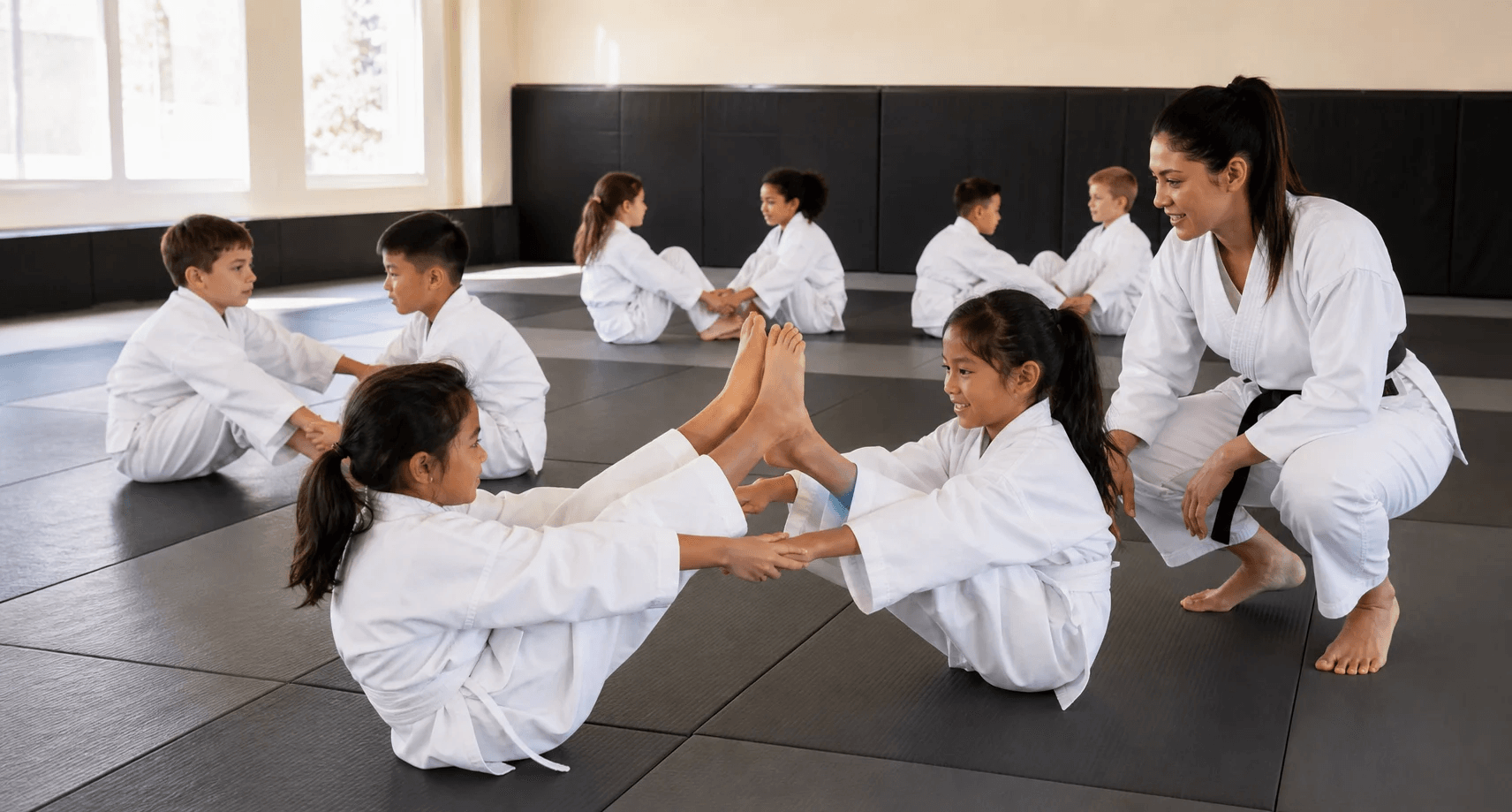
A kids class can look successful from the mat while the program behind it is fragile. The room is busy, the children are moving, and parents are watching. Yet the academy may still depend on one instructor, an improvised curriculum, and messages sent only when something goes wrong.
A good kids martial arts program feels simple to families because the academy has done the difficult work in advance. The class has a clear purpose. Instructors know what to teach and how to respond. Parents understand the process. Progress is visible without being rushed.
This guide covers that operating system. It applies to karate, taekwondo, judo, Brazilian Jiu-Jitsu, MMA, and multi-discipline academies, with room for each discipline to keep its own technical and grading standards.
Key takeaways
- Build the program around a clear promise to families, then design the timetable and curriculum to support it.
- Group children by developmental needs and safe partner fit, not by belt or age alone.
- Prepare instructors for communication, supervision, and child-protection responsibilities as carefully as you prepare the curriculum.
- Give parents a defined onboarding process and a reliable communication rhythm.
- Use attendance, capacity, progress, incidents, and parent feedback to improve the program by class.
Start with the promise, not the timetable
It is easy to begin with an empty slot in the schedule: Tuesday and Thursday at 5 p.m. are available, so that becomes the kids program. A stronger starting point is the experience you intend to provide.
Write one sentence that the whole team can use. For example:
We help children learn age-appropriate martial arts skills in a structured class where effort, respect, and safe practice are recognized.
That sentence creates useful constraints. It says that technical learning matters, but so do structure and conduct. It also avoids promises that the academy cannot control, such as guaranteeing confidence, better grades, or protection in every situation.
Before announcing the program, define the operating limits:
- The ages and experience levels you can serve well.
- The maximum class size for the room and instructor team.
- The instructor and assistant assigned to each session.
- The discipline-specific material that is suitable for each group.
- The process for trials, pickup, injuries, behavior concerns, and parent contact.
- The date when the academy will review demand and results.
Capacity deserves particular attention. A full class is useful only while instructors can still observe every child, match partners responsibly, and intervene early. Set an initial cap, then change it from direct observation rather than ambition.
Design groups around the children in front of you
Age bands are practical for scheduling, but age cannot make every placement decision. Two children of the same age may differ in attention, coordination, size, prior training, and comfort with group instruction.
Use five factors together:
- Developmental stage and ability to follow instructions.
- Physical size and safe partner options.
- Martial arts experience and technical control.
- Social confidence and response to a group setting.
- The level of supervision the child currently needs.
A three-group model can be a useful planning draft:
- Ages 4 to 6: 30 to 40 minutes, with movement, simple routines, and frequent changes of activity.
- Ages 7 to 10: 40 to 50 minutes, with short technical sequences, partner practice, and clear games with a learning purpose.
- Ages 11 to 14: 50 to 60 minutes, with longer technical blocks and a gradual bridge toward the academy’s teen or adult curriculum.
These ranges are examples, not industry standards. A judo class, a karate class, and a youth MMA class carry different technical demands. Local federation rules may also define age divisions or restricted material. Review the real group after the first month and move students when the current placement no longer serves them.
Give every class a dependable shape
Children should know what happens when they enter, where equipment belongs, how partners are chosen, and how the session closes. Predictability reduces administrative noise and gives instructors more time to teach.
A 45-minute class might use this structure:
- Arrival and opening, 5 minutes. Greet each child, confirm attendance, and set one behavioral and one technical focus.
- Movement preparation, 7 minutes. Use age-appropriate games or drills connected to the skills that follow.
- Review, 5 minutes. Return to one familiar movement so every student begins with a reachable task.
- New material, 10 minutes. Teach one small sequence with a short demonstration and a clear safety rule.
- Partner practice, 12 minutes. Match students deliberately and give instructors a simple observation goal.
- Close, 6 minutes. Cool down, recognize specific effort, and tell children what they will revisit next time.
The timings matter less than the rhythm. Long explanations create idle time. Unstructured games make it difficult to see what children are learning. A class plan should alternate listening, movement, practice, and feedback before attention fades.
Prepare a simpler version of every activity. That gives an instructor a useful response when a child is new, tired, anxious, or not ready for the full task. It also keeps adaptation inside the class instead of making the child feel removed from it.
Prepare instructors for more than technique
Technical knowledge does not automatically make someone effective with children. Kids instructors need to set boundaries calmly, explain one idea at a time, notice changes in behavior, and speak with parents without discussing another child.
Create a written instructor standard that covers:
- How attendance, arrival, and authorized pickup are recorded.
- When an assistant is required and how supervision is divided.
- How physical contact is explained and kept appropriate to instruction.
- Which techniques, intensity levels, and partner combinations are restricted.
- How injuries, incidents, disclosures, and behavior concerns are documented and escalated.
- How photos, changing areas, messages, and parent communication are handled.
Child-protection and instructor-vetting requirements vary by country. Confirm the current rules with the relevant authority, federation, and insurer before opening enrollment. The academy should also give staff a named person and a written process for raising concerns. A policy that nobody can explain is not yet an operating procedure.
Run short scenario reviews with the team. Discuss what happens when a parent is late, a child refuses a partner, two students become too physical, or an instructor notices a repeated change in behavior. Consistent responses build confidence inside the team and reduce improvisation during a difficult moment.
Treat parent onboarding as part of the program
The child experiences the class. The parent or guardian evaluates the whole service: the first reply, the trial, the pickup process, the clarity of the fees, and what happens when something changes.
Before the first class, give families a short written overview covering:
- Class times, arrival expectations, and pickup rules.
- Uniform or equipment requirements.
- What the first month will include.
- How progression and recognition work.
- Who to contact about absence, injury, billing, or a concern.
- Which messages the academy will send and through which channel.
After the trial, send a personal note that says what the instructor observed and which class would be the best fit. Avoid a generic sales sequence when the family needs a placement decision.
Once enrolled, use a communication rhythm that the team can sustain. A monthly curriculum update, early notice of timetable changes, and direct contact after an incident give parents useful visibility without filling every week with announcements. MatGoat’s communications tools can keep group updates and academy notices in one place.
Make progress visible without turning it into a prize schedule
Children benefit from knowing that their work has been noticed. Parents also need to understand what development looks like between major gradings. That visibility can include belts, stripes, certificates, skill cards, instructor notes, or a brief conversation after class.
Use recognition for specific behaviors and skills:
- Returning to a difficult task after a mistake.
- Practicing with control and protecting a partner.
- Remembering a technical detail from the previous class.
- Helping the group follow a routine.
- Meeting the published requirements for a grade or milestone.
Attendance can inform an instructor because practice requires time, but it should not become the only grading criterion. Combine consistency with technical assessment, safe application, conduct, and the rules of the discipline.
Explain the system before a family asks why a promotion has not happened. Publish the criteria you can make public, record each promotion, and give a constructive next step when a child needs more time. For a discipline-specific example, the guide to building a BJJ program for kids covers youth belts, stripes, and parent communication in more detail.
Watch the signals that appear before a cancellation
Retention is easier to understand when the academy reviews classes rather than relying on a general impression. A healthy total membership figure can hide one age group that is losing students or one session that has become too crowded.
Review these signals every month:
| Signal | What to examine | Possible response |
|---|---|---|
| Trial conversion | Whether families understood the offer and received a clear placement recommendation. | Improve the trial follow-up or class-fit process. |
| Attendance change | Children whose usual pattern has declined. | Contact the family personally and ask what has changed. |
| Class capacity | Student count compared with safe supervision and partner options. | Add an assistant, split the group, or pause new enrollment. |
| Progress gaps | Students receiving little feedback or no recorded milestone. | Review assessment notes and give a specific next step. |
| Incidents | Repeated issues by activity, group, time, or partner match. | Change the drill, supervision plan, or group placement. |
| Parent feedback | Themes in questions, concerns, and positive comments. | Clarify onboarding or adjust the operating process. |
A missed class does not require an alarm. A meaningful change from a child’s normal pattern deserves attention. Set a threshold the team can follow, such as three consecutive missed classes or two weeks without attendance, then make the first contact personal. Attendance tracking in MatGoat helps instructors see the pattern before the family reaches the cancellation stage.
Use a 30-day launch and review cycle
You do not need a perfect twelve-month program before the first trial. You need a safe, teachable first version and a date for reviewing it.
Before enrollment opens
- Define the program promise, age range, timetable, capacity, and price.
- Assign instructors and assistants with clear responsibilities.
- Write the first four weeks of class plans and the allowed technical material.
- Confirm child-protection, insurance, pickup, incident, and communication procedures.
- Prepare the parent overview, trial form, and follow-up message.
During the first four weeks
- Record attendance from the first class.
- Ask instructors for a short note after every session.
- Check partner matching and class size weekly.
- Contact trial families with a specific placement recommendation.
- Record parent questions instead of answering the same uncertainty repeatedly.
At the 30-day review
- Compare enrollment, trial conversion, attendance, capacity, and incidents by class.
- Ask instructors which activities worked and where attention dropped.
- Ask a small group of parents what felt clear and what did not.
- Change one or two operating points, then set the next review date.
The first review should produce decisions, not a larger document. Adjust the class length, move an age boundary, add an assistant, rewrite the welcome message, or remove an activity that is not working.
Build the program parents can understand
Families do not see every curriculum meeting or instructor review. They experience the result: a child is greeted by name, the class has purpose, progress makes sense, and the academy communicates before confusion grows.
Choose one part of the program to formalize this week. Write the class template, parent overview, attendance threshold, or instructor procedure, then test it in the next session.
Keep attendance, family communication, and student progress in one place. See MatGoat’s current offer for martial arts academies.
Frequently asked questions
What age should children start martial arts?
There is no universal starting age. The right point depends on the child's readiness, the discipline, and whether the academy has instructors, class lengths, and activities designed for that developmental stage.
How should a martial arts academy divide kids classes?
Use developmental stage, attention needs, physical size, experience, and safe partner matching together. Age bands are a useful starting point, but instructors should review the actual group instead of treating age as the only rule.
How long should a kids martial arts class be?
Younger groups often need shorter classes and more frequent activity changes, while older children can manage longer technical blocks. Treat 30 to 60 minutes as a planning range and adjust it after observing attention, safety, and learning.
How can academies improve retention in a kids program?
Give children a predictable class, visible progress, and instructors who know them. Give parents clear expectations, timely updates, and early contact when attendance changes. Track these signals by class so you can improve the program from evidence.

Founder of MatGoat and a software engineer with more than 20 years of experience building software products. He has practiced BJJ since 2021 and develops MatGoat using feedback from martial arts academies.
View full profile

