
IBJJF Rule Changes 2027: Complete Guide by Belt and Division
Review all 13 official IBJJF rule changes taking effect January 1, 2027, including white-belt foot locks, jumping guard DQ, lapel timers, and No-Gi gear.
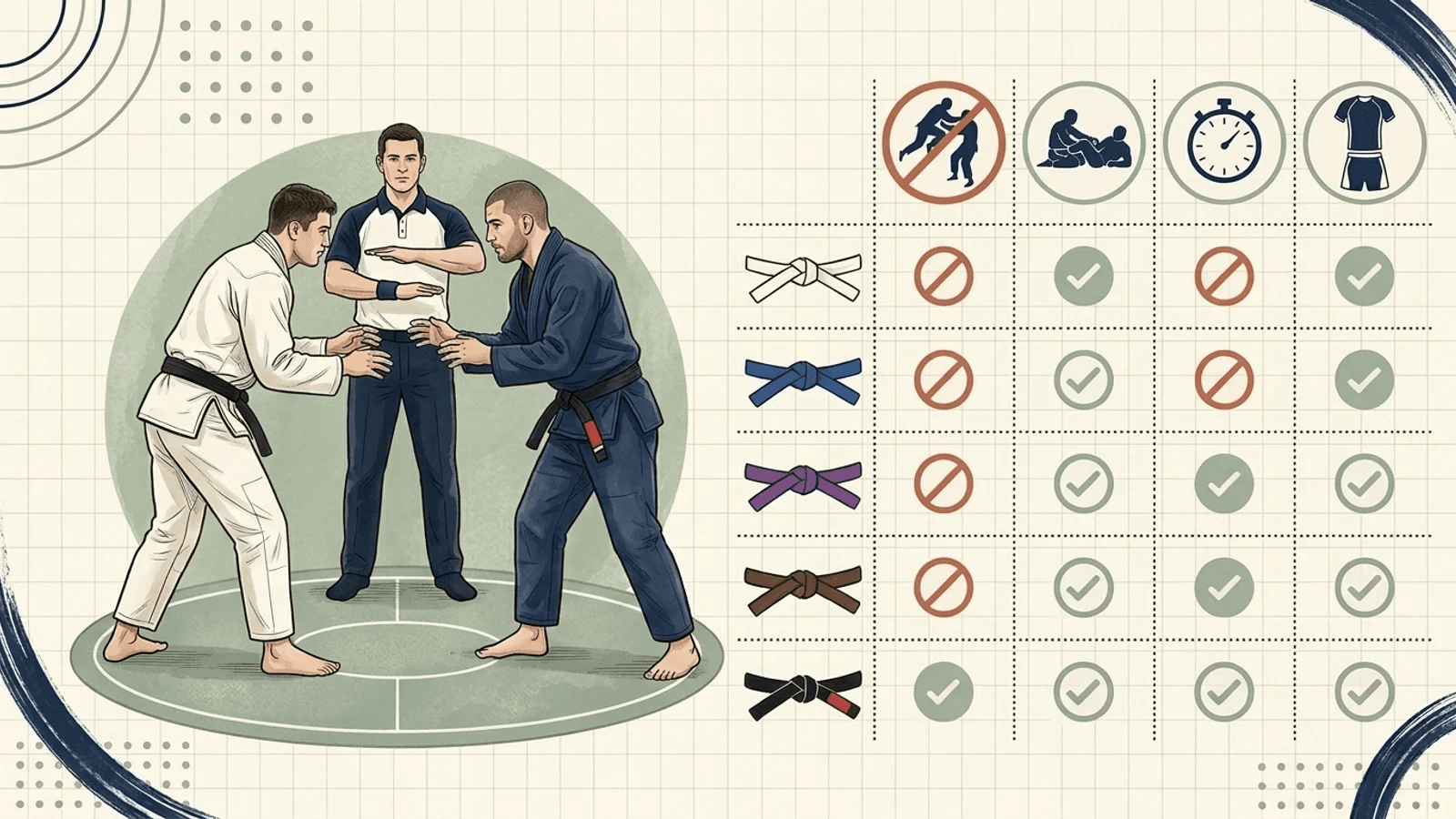
The International Brazilian Jiu-Jitsu Federation (IBJJF) has published 13 rule updates that take effect on January 1, 2027. Compared against Rules Book v6.1 (June 2024), the revision reshapes beginner submissions, jumping-guard penalties, stalling clocks in double guard and lapel entanglements, No-Gi uniform inspections, and senior age brackets.
Several changes alter match strategy immediately. White belts and 16- to 17-year-old juveniles lose access to the straight foot lock, jumping guard in restricted divisions becomes an instant disqualification rather than a reset, and blue and purple belts gain permission to turn toward the unattacked foot during straight ankle locks.
Use the interactive explorer below to filter all 13 official updates by your competitor division, belt rank, rule category, or official demonstration videos, with side-by-side comparisons between the 2024 wording and the 2027 rulebook.
Effective January 1, 2027
Explore all 13 IBJJF rule changes for 2027
Filter the official 2027 updates by division, belt, rule category, or example videos, and compare each change against Rules Book v6.1 (June 2024).
“Before” summarizes the June 2024 text (Rules Book v6.1) that remains in force through December 31, 2026.
“2027 Rule” summarizes the official IBJJF wording and refereeing guidance taking effect on January 1, 2027.
- Fouls and illegal moves 6.2.3 M (7.1) Updated rule Example video
Jumping to closed guard becomes a severe foul with immediate disqualification
Jumping for closed guard on a standing opponent, including flying triangles, flying armbars, and any other attack initiated by jumping guard, triggers immediate disqualification at the moment of the infraction.
Applies to: Divisions up to 15 years old (all belts) and white belts of all age groupsBefore (Rules Book v6.1)
Rule 6.2.2 W classified jumping guard in under-15 divisions and white belt age groups as a serious foul: the referee stood both athletes up, recorded a penalty, and awarded 2 points to the opponent only if the jump countered a takedown or sweep.
2027 Rule (effective Jan 1, 2027)
Rule 6.2.3 M moves the infraction into severe technical fouls: jumping for closed guard or initiating any flying submission by jumping guard on a standing opponent causes summary disqualification under Rule 7.1.
Example video: jumping to closed guard on a standing opponent results in immediate disqualification Official IBJJF video (demonstration only) - Fouls and illegal moves 6.2.3 N (Row 12) Updated rule Example video
Straight foot lock rotation toward the unattacked foot allowed for blue and purple belts
During a straight foot lock, turning toward the foot not under attack (belly-down or inside rotation) is now legal for Adult through Master 8 blue and purple belts, matching brown and black belts.
Applies to: Blue and purple belts from Adult through Master 8 (Gi and No-Gi)Before (Rules Book v6.1)
Rules Book v6.1 (6.2.3 M, Illegal Moves Table item 16) prohibited turning toward the foot not under attack during a straight foot lock up through Adult and Master purple belt.
2027 Rule (effective Jan 1, 2027)
Rules Book 2027 (6.2.3 N, Illegal Moves Table item 12) restricts this rotation only in divisions up to age 17 and Adult through Master 8 white belts, where the straight foot lock itself is now prohibited.
Example video: turning toward the foot not under attack during a straight foot lock (now permitted at blue and purple belt) Official IBJJF video (demonstration only) - Fouls and illegal moves 6.2.3 N (Row 8) Updated rule
Straight foot lock becomes illegal for juveniles (16 and 17) and all white belts
The straight ankle lock is no longer permitted for 16- and 17-year-old juveniles of any belt or for Adult and Master white belts. Legal foot locks in IBJJF competition now begin at Adult blue belt.
Applies to: Juveniles aged 16 and 17 (all belts) and white belts from Adult through Master 8Before (Rules Book v6.1)
Rules Book v6.1 (6.2.3 M, Illegal Moves Table item 3) marked the straight foot lock as illegal only in the 4-to-12 and 13-to-15 age divisions.
2027 Rule (effective Jan 1, 2027)
Rules Book 2027 (6.2.3 N, Illegal Moves Table item 8) extends the straight foot lock prohibition to Column 3: ages 16 and 17 (all belts) and white belts from Adult through Master 8.
- Scoring 4.1.12 Updated rule Example video
Takedown points against a suspended closed-guard pull: 3-second drop timer removed
When an athlete holds the pants and the opponent jumps or pulls into a suspended closed guard, the top athlete no longer has to put the opponent down within 3 seconds. Causing the opponent to land on their back, sideways, or seated and stabilizing top position for 3 seconds awards 2 takedown points.
Applies to: All athletesBefore (Rules Book v6.1)
Rule 4.1.12 Note required the standing athlete with a pants grip to put the suspended opponent’s back on the mat within 3 seconds and stabilize top position for 3 seconds to score takedown points.
2027 Rule (effective Jan 1, 2027)
Rule 4.1.12 Note removes the 3-second countdown to put the opponent down and accepts landing the opponent on their back, sideways, or seated, while keeping the 3-second top stabilization requirement.
Example video: scoring takedown points after an opponent pulls into a suspended closed guard Official IBJJF video (demonstration only) - Lack of combativeness 6.2.1 C Updated rule Example video
Double guard pull: referee stops and penalizes after 20 seconds even with a submission or imminent score
After a simultaneous double guard pull, one athlete must actually reach top position or score within 20 seconds. Holding a submission or nearly completing a sweep no longer prevents the referee from stopping the match, penalizing both athletes, and restarting standing.
Applies to: All athletesBefore (Rules Book v6.1)
Rule 6.2.1 C allowed play to continue past the 20-second double-guard-pull countdown if an athlete reached top position, held a submission, or was imminently completing a point-scoring move.
2027 Rule (effective Jan 1, 2027)
Rule 6.2.1 C states that if neither athlete has reached top position or scored at the end of 20 seconds, the referee stops the match, penalizes both athletes, and restarts standing regardless of active submissions or imminent points.
Example video: 20-second double guard pull countdown stopping play despite an active submission or sweep attempt Official IBJJF video (demonstration only) - Lack of combativeness 6.2.1 G (7.3.1) New rule Example video
Lapel or belt grip wrapping the athlete’s own leg triggers a 20-second progression clock
When an athlete grips the opponent’s lapel or belt and wraps their own leg in a controlling configuration, they have 20 seconds to achieve positional progression or receive a lack-of-combativeness penalty, regardless of intention.
Applies to: All athletes2027 Rule (effective Jan 1, 2027)
New Rule 6.2.1 G requires positional progression within 20 seconds whenever an athlete grips the opponent’s lapel or belt and wraps their own leg in a controlling position; otherwise a penalty is issued under Rule 7.3.1 regardless of attacking intent.
Example video: 20-second progression clock when gripping the lapel or belt and wrapping one’s own leg in control Official IBJJF video (demonstration only) - Disciplinary 6.1.7 & 6.1.8 New rule
New disciplinary disqualifications for intentional fouls or reckless risk of injury
The IBJJF can upgrade a severe foul to a full disciplinary disqualification if committed intentionally or with disproportionate force, and can issue a disciplinary disqualification for any conduct meant to injure or knowingly risking injury even if not listed as a severe foul.
Applies to: All athletes2027 Rule (effective Jan 1, 2027)
New Rules 6.1.7 and 6.1.8 empower the IBJJF, upon formal request by the event’s Referee Coordinator, to convert intentional or disproportionate-force severe fouls into disciplinary disqualifications and to sanction any unlisted action performed with intent or knowing risk of injuring the opponent.
- Referee gestures Article 1 New rule
New official referee gesture: request to calm down
Article 1 adds a standardized non-verbal referee gesture instructing one or both competitors to calm down during heated exchanges without stopping the clock for a verbal lecture.
Applies to: All athletes2027 Rule (effective Jan 1, 2027)
Article 1 (Referee Gestures): the referee raises both hands in front of the torso with palms facing forward, then lowers and extends the arms with palms facing down, with no verbal command.
- Scoring 1.3.7 New rule
Match interrupted with a submission hold in place awards 2 points and restarts standing
If a match must be stopped while a submission is locked in, for reasons not attributable to either athlete and where no other specific rule procedure applies, the athlete applying the submission receives 2 points and the match restarts standing in the center.
Applies to: All athletes2027 Rule (effective Jan 1, 2027)
New bullet in Rule 1.3.7: when an unattributable interruption occurs with a submission hold in place and no specific procedure is defined elsewhere in the Rules Book, the referee restarts both athletes standing in the center and signals 2 points for the attacking athlete.
- Progression concept Refereeing criterion Refereeing criterion Example video
Positional progression concept extended to guard passing evaluations
Without changing the printed text of the Rules Book, IBJJF referees now apply the same positional progression standard already used in sweeps when judging guard-passing sequences.
Applies to: All athletesBefore (Rules Book v6.1)
Referees formally applied the progression concept to evaluate continuous sweep sequences.
Example video: progression concept in a sweep (already applied) Official IBJJF video (demonstration only) 2027 Rule (effective Jan 1, 2027)
The progression concept remains applied to sweeps and is now formally applied to guard passing as well (interpretive guidance; Rules Book wording unchanged).
Example video: progression concept in guard passing (now also applied in 2027) Official IBJJF video (demonstration only) - No-Gi uniform 8.1.16 Updated rule No-Gi
No-Gi uniform overhaul: distinct rash guard rules for white, colored, and black belts plus shorts hem limit
White belts must wear a predominantly white rash guard (>50%) with black as the only secondary color; black belts need a predominantly black rash guard (>50%) with white as the only secondary color (plus a small red area); colored belts (grey to brown) keep the 10% rank-color requirement visible from both front and back. Shorts cannot pass the knee and the hem may sit at most 15 cm above mid-knee (kids must cover at least half the thigh).
Applies to: All No-Gi athletes (including a dedicated white-belt rule across all ages)Before (Rules Book v6.1)
Rule 8.1.16 applied a single 10% rank-color rule on black, white, or black-and-white rash guards across all belts, and required shorts to cover at least halfway down the thigh (no more than 15 cm from the knee) without passing the knee.
2027 Rule (effective Jan 1, 2027)
Rule 8.1.16 separates three rash guard tiers: white belts (>50% white, black only secondary), colored belts grey through brown (at least 10% rank color clearly visible from front and back, or 100% rank color), and black belts (>50% black, white only secondary plus small red area). Shorts must not pass the knee and sit at most 15 cm above the middle of the knee (kids: at least halfway down the thigh).
- Age divisions 1.3, 3.3.2 & 6.2.3 N Updated rule
New Master 8 division (66 and older) with 4-minute matches; Master 7 becomes ages 61 to 65
Athletes turning 66 or older in the competition year now compete in Master 8 with 4-minute matches, while Master 7 narrows to ages 61 through 65 at 5 minutes. Master 8 is also added to the Illegal Moves Table and tie-break rules.
Applies to: Athletes aged 61 and older (Master 7 and Master 8)Before (Rules Book v6.1)
Rule 1.3 ended at Master 7 for all athletes with (Current Year - Birth Year) >= 61, scheduled for 5-minute matches.
2027 Rule (effective Jan 1, 2027)
Rule 1.3 keeps Master 7 (ages 61 to 65) at 5 minutes and adds Master 8 ((Current Year - Birth Year) >= 66) at 4 minutes; Rules 3.3.2 and 6.2.3 N update range references to “Adult to Master 8.”
- No-Gi uniform 8.1.16 Updated rule No-Gi
Men’s No-Gi uniform now permits full-length compression pants (spats) worn under shorts
Male No-Gi competitors may now wear skin-tight full-length compression pants (spats) and/or compression shorts underneath their regulation shorts, in black, white, black and white, and/or their belt rank color.
Applies to: Male No-Gi athletesBefore (Rules Book v6.1)
Rule 8.1.16 allowed male athletes to wear skin-tight compression shorts beneath their No-Gi shorts, without permitting full-length compression pants (spats).
2027 Rule (effective Jan 1, 2027)
Rule 8.1.16 permits skin-tight compression pants (spats) and/or compression shorts worn beneath men’s shorts, in black, white, black and white, and/or the athlete’s belt color (board shorts on top remain mandatory).
No 2027 rule changes match this search and filter combination.
Jumping guard and straight foot locks shift across belt ranks
The first three updates modify technical fouls and leg-lock boundaries across beginner and intermediate divisions:
- Immediate disqualification for jumping guard (
6.2.3 M): In divisions up to 15 years old (all belts) and across every white belt age group, jumping for closed guard on a standing opponent moves from serious fouls (6.2.2 W) to severe technical fouls (6.2.3 M). Any attack initiated by jumping guard, including flying triangles and flying armbars, now causes summary disqualification at the moment of the infraction (7.1) instead of a standing restart - Straight foot lock prohibited for juveniles and white belts (
6.2.3 N, row 8): Juveniles aged 16 and 17 at every belt and white belts from Adult through Master 8 can no longer apply the straight ankle lock. Legal foot attacks in IBJJF events now begin at Adult or Master blue belt - Belly-down ankle lock rotation allowed at blue and purple belt (
6.2.3 N, row 12): Turning in the direction of the foot not under attack during a straight foot lock is no longer prohibited for Adult through Master 8 blue and purple belts, aligning their straight-ankle finishing mechanics with brown and black belts
Coaches preparing novice rosters before January should separate sparring habits early. White belts who rely on straight ankle locks from 50/50 or single-leg X must redirect those entries toward sweeps and guard passes, while newly promoted blue belts can train inside and belly-down finishing angles legally. Reducing uncontrolled jumping-guard impacts and early ankle-lock cranking also addresses two frequent mechanisms behind common BJJ knee and ankle injuries.
How the 2027 Illegal Moves Table (6.2.3 N) renumbers rows
Moving the straight foot lock into the juvenile and white-belt block changes the row order of the official 26-row matrix. Old row 3 (Straight foot lock) moves down to row 8, shifting five upper-body and choke restrictions up into rows 3 through 7 (sleeve Ezekiel choke, technical front guillotine, omoplata, triangle pulling the head, and arm triangle). Meanwhile, turning toward the unattacked foot in a straight foot lock moves from row 16 up to row 12, shifting biceps slicers, calf slicers, kneebars, and toe holds into rows 13 through 16.
2027 matrix category (6.2.3 N) | Prohibited rows in 2027 | Change vs. v6.1 (June 2024) |
|---|---|---|
| Ages 4 through 12 | 1 through 26 (26 rows) | Unchanged count |
| Ages 13 through 15 | 2 through 26 (25 rows) | Unchanged count |
| Ages 16 and 17 (all belts) and white belt (Adult to Master 8) | 8 through 26 (19 rows) | Adds straight foot lock at row 8 (+1 prohibited move) |
| Blue and purple belts (Adult to Master 8) | 13 through 26 (14 rows) | Allows straight foot lock turn toward unattacked foot (-1 prohibited move) |
| Brown and black belts (Adult to Master 8, except Adult No-Gi) | 17 through 26 (10 rows) | Expands age label to Master 8 |
| Adult brown and black belts No-Gi | 21 through 26 (6 rows) | Unchanged (Master divisions remain excluded) |
For tournaments running before January 1, 2027, and for visual references on knee reaping, slams, suplexes, and the non-penalized head-outside single leg at row 11, check our breakdown of IBJJF illegal moves by belt and age. Academies running youth classes can combine this updated matrix with a structured BJJ kids program so teenagers aged 16 and 17 transition cleanly under the juvenile ban.
Scoring, double guard pulls, and the 20-second lapel clock
Five updates refine how referees score interrupted scrambles, punish stalling on the mat, and evaluate passing sequences.
Suspended closed-guard pulls (4.1.12)
When an athlete holds the opponent’s pants and the opponent pulls closed guard while staying suspended in the air, Rules Book v6.1 forced the standing athlete to put the opponent’s back on the mat within three seconds to earn takedown points. The 2027 text removes that three-second drop deadline and broadens the landing condition: causing the suspended opponent to land on their back, sideways, or seated and stabilizing top position on the ground for three seconds awards the two takedown points.
Stricter 20-second double guard pull cutoff (6.2.1 C)
Under the previous rule, a simultaneous double guard pull was not stopped after 20 seconds if one athlete held a submission or was imminently completing a scoring technique. Beginning in 2027, if neither athlete has actually reached top position or put points on the board when the 20-second countdown expires, the referee stops the match, penalizes both competitors, and restarts them standing regardless of locked submissions or near-sweeps.
New 20-second timer on leg-wrapped lapel or belt grips (6.2.1 G)
A brand-new combativeness provision targets positions where an athlete grips the opponent’s lapel or belt and wraps their own leg in a controlling configuration (such as worm-guard or belt-wrap entanglements). Once that wrap is established, the athlete has 20 seconds to achieve positional progression. Failing to advance within 20 seconds triggers a lack-of-combativeness penalty under Rule 7.3.1, regardless of attacking intent.
Match stoppages with a locked submission (1.3.7) and guard-pass progression
Rule 1.3.7 adds a clear fallback for unusual match interruptions: if play stops while a submission hold is in place for reasons not attributable to either competitor, and no other specific rulebook procedure governs that scenario, both athletes restart standing in the center and the athlete applying the submission receives two points. Separately, IBJJF officials will now apply the positional progression concept, previously used to judge multi-step sweeps, when evaluating guard-passing sequences as well. That instruction guides refereeing interpretation without altering the printed text of the book.
Disciplinary disqualifications and the new referee signal
Two additions expand athlete safety and mat control during heated matches. New Rules 6.1.7 and 6.1.8 allow the IBJJF, upon formal request from the event’s Referee Coordinator, to issue a disciplinary disqualification in two situations:
- Converting a severe foul into a disciplinary disqualification when committed intentionally or by knowingly assuming the risk of injuring the opponent, including disproportionate force (
6.1.7) - Performing any action, technique, or conduct intended to injure the opponent or knowingly risking injury, even when the movement is not listed among standard severe fouls (
6.1.8)
Unlike a technical disqualification that ends only the current match, a disciplinary disqualification removes the competitor from the championship (including both Gi and No-Gi divisions when registered in both). At the preventive end, Article 1 adds an official non-verbal “calm down” referee gesture: raising both hands in front of the torso with palms forward, then lowering and extending the arms with palms facing down.
No-Gi uniform overhaul (8.1.16) and Master 8 (1.3)
No-Gi competitors face stricter rank-visibility standards at uniform check starting in 2027. Instead of applying one 10% belt-color rule to every rank, Rule 8.1.16 splits rash guard requirements into three distinct groups:
| Belt group | 2027 No-Gi shirt / rash guard rule (8.1.16) |
|---|---|
| White belt (all ages) | Predominantly white (over 50% of the surface); black is the only allowed secondary color |
| Colored belts (grey through brown) | Black, white, or black-and-white shirt with at least 10% rank color clearly identifiable from both front and back, or 100% rank color |
| Black belt | Predominantly black (over 50% of the surface); white is the only secondary color, plus a small red area that does not obscure rank |
Rash guards must remain skin-tight and long enough to cover the shorts waistband, with no extra colors outside brand or academy logos. Shorts for men and women cannot extend past the knee, and the bottom hem may sit at most 15 cm above the middle of the knee (kids’ shorts must cover at least half the thigh). In addition, Item 13 updates Rule 8.1.16 so male No-Gi athletes may wear full-length skin-tight compression pants (spats) and/or compression shorts underneath their regulation shorts in black, white, black-and-white, and/or rank color. If you switch between kimono and submission grappling events, review our comparison of Gi vs. No-Gi BJJ and our guide to BJJ belt order and ranks.
Finally, Rule 1.3 introduces Master 8 for athletes turning 66 or older (Current Year - Birth Year >= 66), contested over four-minute matches. Master 7 now covers ages 61 through 65 at five minutes, and references across tie-breaks (3.3.2) and the Illegal Moves Table (6.2.3 N) expand to “Adult to Master 8.”
Official sources, review date, and tournament preparation
This guide was compiled on November 25, 2026 directly from the official IBJJF Rule Changes 2027 bulletin, the 2027 No-Gi Uniform Photo Guide, and Rules Book v6.1 (June 2024) listed under IBJJF Books and Videos. Whenever a question arises on the mat, the full wording of the current IBJJF Rules Book prevails over summary charts.
Note that other grappling circuits enforce entirely different leg-lock, guard-pull, and uniform standards; check our overview of major BJJ competitions if you also compete in ADCC, AJP, or sub-only events.
Filter the explorer above for your 2027 division with your coach, inspect your No-Gi kit against the new 50% and 15 cm thresholds, and adjust sparring rounds before the January calendar begins.
Frequently asked questions
When do the 2027 IBJJF rule changes take effect?
All 13 updates take effect on January 1, 2027. Tournaments held through December 31, 2026 continue to follow IBJJF Rules Book v6.1 (June 2024).
Are straight ankle locks legal for IBJJF white belts and juveniles in 2027?
No. Starting January 1, 2027, the straight foot lock moves to row 8 of the Illegal Moves Table (Rule 6.2.3 N) and becomes a severe foul for 16- and 17-year-old juveniles at all belts and for white belts from Adult through Master 8.
What happens if a white belt jumps to closed guard in 2027?
Rule 6.2.3 M reclassifies jumping to closed guard on a standing opponent, including flying triangles and flying armbars, as a severe technical foul. In divisions up to 15 years old and across all white belt age groups, the athlete is immediately disqualified under Rule 7.1.
Can IBJJF blue and purple belts turn belly-down on a straight foot lock in 2027?
Yes. Turning toward the foot not under attack during a straight foot lock (row 12 in the 2027 table) is now permitted for blue and purple belts from Adult through Master 8, matching brown and black belts.
What changes for IBJJF No-Gi rash guards and men's spats in 2027?
Rule 8.1.16 requires white belts to wear a predominantly white shirt (over 50% white, black as the only secondary color) and black belts a predominantly black shirt (over 50% black, white secondary plus a small red area), while colored belts keep at least 10% belt color visible front and back. Men may also wear full-length compression pants (spats) underneath shorts.

Founder of MatGoat and a software engineer with more than 20 years of experience. He has practiced BJJ since 2021 and develops MatGoat using feedback from martial arts academies.
View full profile

