
What Is Taijutsu: Technique and Tradition
Explore Taijutsu origins in Japan, the six technical pillars of Nihon Tai-Jitsu, the kyu ranking system, and key differences with Jiu-Jitsu.
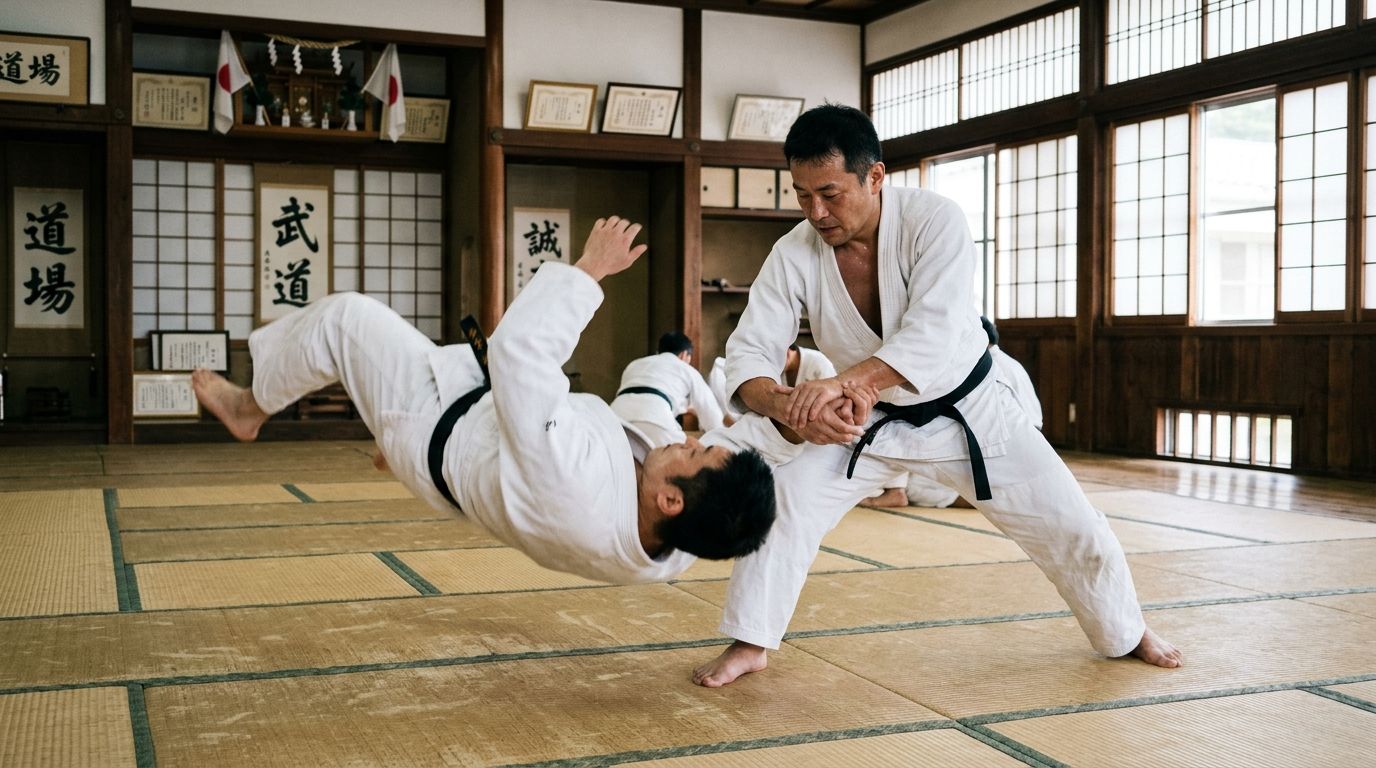
The Japanese term Taijutsu (体術) translates directly as “body art” or “body technique”. It denotes an unarmed combat method focused on personal defense, applied biomechanics, and the rational redirection of an assailant’s momentum.
While its tactical and philosophical heritage originates in feudal Japan, the modern discipline most widespread throughout Europe, Nihon Tai-Jitsu, features a rigorous pedagogical structure established to teach classical principles through clear educational frameworks.
Historical Origins and Evolution
Written documentation of unarmed disciplines classified under the broader heading of taijutsu dates to twelfth-century Japan. During this era of persistent warfare, military clans (bushi) required dependable empty-hand fighting systems when disarmed or engaged in close quarters on the battlefield.
These unarmed skills carried various regional designations across centuries, including kumiuchi, yawara, kogusoku, and taijutsu. Unlike modern combat sports constrained by weight divisions and referee interventions, classical methods sought the rapid neutralization of armored or armed adversaries through off-balancing (kuzushi), percussive strikes to exposed anatomical vulnerabilities, and destructive joint locks.
During the twentieth century, senior martial artists sought to preserve this practical heritage without sacrificing civilian relevance. Master Roland Hernaez, working in close collaboration with Japanese and European masters, unified these traditional elements into Nihon Tai-Jitsu, creating a progressive curriculum that blends classical jujutsu principles with modern analytical teaching methods.
Philosophical and Psychological Dimensions
Studying Taijutsu extends beyond repetitive physical conditioning. Sustained practice demands cognitive discipline that refines how individuals evaluate and respond to physical confrontation:
- Mechanical efficiency and economy of motion. Rather than matching force against force, practitioners redirect aggressive momentum using angular evasions (tai sabaki) and progressive leverage.
- Stress inoculation and emotional composure. Structured pressure drills accustom the nervous system to acute stress, conditioning practitioners to regulate respiration and maintain tactical awareness.
- Proportionality and ethical defense. Martial doctrine mandates resolving confrontations with the minimum force required to control a threat, adhering strictly to legal and ethical standards.
- Dojo protocol and mutual responsibility. Consistent partner practice across varying skill levels cultivates empathy, precision during joint lock execution, and mutual confidence.
The Six Technical Pillars of Nihon Tai-Jitsu
To foster coherent skill acquisition, Nihon Tai-Jitsu organizes its comprehensive syllabus into six interconnected technical divisions, progressing from isolated motor drills to spontaneous sparring:
1. Kihon Waza (Fundamental Techniques)
This section establishes foundational neuromuscular coordination. It codifies the practitioner’s mechanical repertoire into structured series:
- Linear, circular, and diagonal body repositioning (tai sabaki).
- Balanced postures and stable rooting (shisei).
- Deflections and parries utilizing upper and lower limbs.
- Percussive strikes (atemi) delivered with fists, open palms, elbows, knees, and feet.
- Joint locks (kansetsu waza), throws (nage waza), and ground immobilization holds.
2. Katas (Prearranged Formal Sequences)
Katas consist of prearranged tactical exchanges executed individually or with a designated partner. They simulate confrontations against predetermined attacks. Consistent kata execution cultivates spatial awareness, respiratory control, mental concentration, and biomechanical precision without the injury risks of uncontrolled impact.
3. Base Techniques
This division focuses on immediate responses to physical restraint. It is codified into 24 fundamental techniques responding to 8 distinct wrist grips. By mastering this core matrix, students internalize universal principles of leverage, joint rotation, and unbalancing, which translate directly to releases from lapel grabs, neck clinches, and clothing seizures.
4. Self-Defense (Ju-Jitsu / Goshin Jutsu)
Self-defense synthesizes kihon, katas, and base techniques for unscripted civilian scenarios. Training introduces variable factors: unexpected assaults, rear ambushes, choke attempts, and defenses against blunt or edged weapons such as knives and sticks. Students also practice behavioral recognition to identify environmental hazards and preempt physical engagement.
5. Randori (Dynamic Free Practice)
Randori provides open-ended exchange within the dojo. Partners engage without predetermined attacks. Adjusted to each practitioner’s grade, this dynamic drill develops:
- Combat distance regulation (maai).
- Spontaneous timing and opportunistic counters.
- Cardiovascular stamina and decision-making under physical fatigue.
- Fluid technical transitions without postural tension.
6. Budoshin (Philosophy, Ethics, and History)
Budoshin preserves the ethical foundation of Japanese budo. It instructs practitioners in classical school traditions (ryu), dojo etiquette, and the imperative of non-violence, reinforcing that martial expertise must function exclusively as an instrument of lawful protection against unprovoked hostility.
Belt Progression and Uniformity
Training takes place in a standard white keikogi (often referred to as a taijitsugi), secured with the belt denoting technical rank.
Progression follows two successive rank hierarchies: Kyu ranks (introductory and intermediate stages) and Dan ranks (black belt senior levels).
Kyu Ranks (Colored Belts)
Formal study begins at 6th Kyu and descends numerically to 1st Kyu as practitioners demonstrate competence before dojo instructors:
- 6th Kyu: White Belt (introductory breakfalls, stance mechanics, and dojo etiquette).
- 5th Kyu: Yellow Belt (fundamental striking series and primary grip releases).
- 4th Kyu: Orange Belt (dynamic evasive footwork and hip throws).
- 3rd Kyu: Green Belt (shoulder and wrist locks applied in motion).
- 2nd Kyu: Blue Belt (complex base combinations and technical ground controls).
- 1st Kyu: Brown Belt (tactical refinement, continuous randori, and preparation for black belt examination).
Dan Ranks (Black Belts)
Following completion of the kyu syllabus, eligible students may test for 1st Dan (Shodan). Dan ranks progress from 1st Dan through 10th Dan. To preserve standardized technical rigor, examinations for black belt ranks are evaluated by accredited regional or national federation boards.
Organizational and Federation Governance
Internationally, the discipline is coordinated by the Fédération Mondiale de Nihon Tai-Jitsu (FMNITJ), based in France.
In Spain, the art operates under the Real Federación Española de Karate y Disciplinas Asociadas (RFEKDA) through its Departamento Nacional de Nihon Tai Jitsu, recognized by the Consejo Superior de Deportes (CSD) as the sole official entity authorized to issue certified degrees and state-recognized black belts.
Active clubs and regional delegations operate throughout numerous territories, including Andalusia, Aragon, Asturias, Cantabria, Castilla-La Mancha, Castilla y León, Catalonia, the Valencian Community, Extremadura, Galicia, and Madrid.
Technical Comparison: Taijutsu versus Brazilian Jiu-Jitsu
While both arts share Japanese roots and trace lineage to feudal grappling systems, their tactical priorities diverge significantly:
- Stance and mobility. Brazilian Jiu-Jitsu (BJJ) deliberately transitions engagements to the mat to eliminate size discrepancies through positional dominance and submission holds. Nihon Tai-Jitsu prioritizes remaining upright, preserving peripheral vision and mobility to evade third-party intervention or dangerous terrain.
- Role of atemi (striking). In sport BJJ, strikes are prohibited. In Taijutsu, concussive strikes serve as an indispensable catalyst to disrupt balance (kuzushi) before initiating a throw or standing submission.
- Weapon defense. Taijutsu incorporates codified defenses against knives, short bludgeons, and broken objects, scenarios that fall outside the parameters of mat-based grappling competition.
Dojo Operations and Academy Management
Managing a successful martial arts academy requires balancing rigorous mat instruction with routine administrative responsibilities. Instructors oversee several recurring logistical operations:
- Recording class attendance to verify mandatory training hours for kyu examinations and national federation testing.
- Organizing curriculum tiers according to developmental age groups, from youth programs to adult classes.
- Processing monthly membership tuition and handling annual federation license renewals.
- Maintaining communication with students and parents regarding upcoming testing dates, seminars, and club events.
Adopting specialized platforms such as MatGoat martial arts management software centralizes these daily processes within one accessible system. By automating attendance check-ins, payment collection, and rank progression tracking, dojo directors spend less time behind desks and more time developing practitioners on the tatami.
Frequently asked questions
What is the technical difference between Taijutsu and Brazilian Jiu-Jitsu?
Taijutsu emphasizes upright self-defense through initial concussive strikes (atemi), joint manipulations, and dynamic throws designed to retain vertical mobility. Brazilian Jiu-Jitsu focuses primarily on takedowns, ground control, and submission grappling via joint locks or chokes.
What is Nihon Tai-Jitsu?
Nihon Tai-Jitsu is a modern, structured martial art rooted in traditional Japanese jujutsu methods, codified to provide a comprehensive self-defense system through systematic progression and classical ethical principles.
What are the six technical pillars of Nihon Tai-Jitsu?
The syllabus comprises Kihon Waza (fundamental techniques), Katas (prearranged forms), Base Techniques (24 codified defenses against wrist grabs), Self-Defense (tactical application against unexpected attacks), Randori (dynamic free practice), and Budoshin (martial ethics, proportionality, and history).

Founder of MatGoat and a software engineer with more than 20 years of experience building software products. He has practiced BJJ since 2021 and develops MatGoat using feedback from martial arts academies.
View full profile

